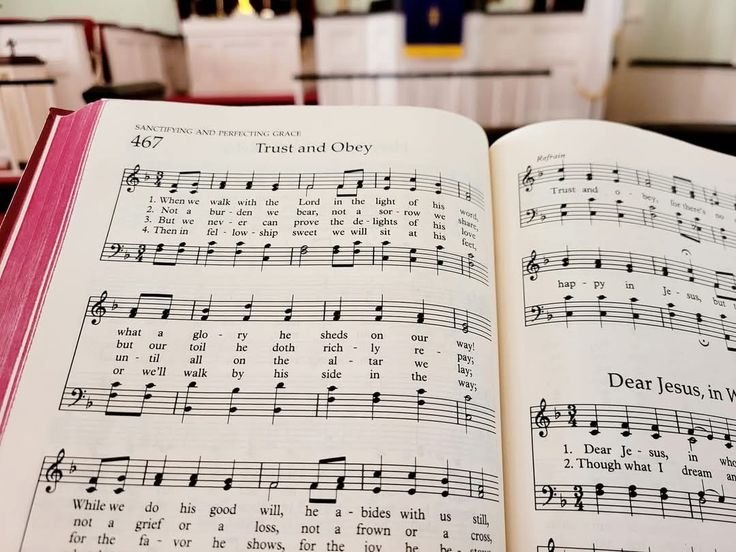
When worshippers gather for a standard Sunday service, most churchgoers expect a hymn to last three to five minutes, spanning roughly four or five stanzas. However, the world of sacred music contains extraordinary anomalies that completely redefine congregational singing. The longest published hymn in history is “Sing God’s Song,” composed by New Zealander Carolyn Ann Aish. Spanning an astonishing 754 stanzas—totaling 3,016 lines of verse accompanied by a repeating four-line refrain—it stands as a monumental work of religious literature. Recognized officially by Guinness World Records, this epic piece transforms the act of singing from a momentary transition in a worship service into an endurance test of spiritual devotion.
Calculating the Vocal Marathon
To truly appreciate the massive scale of Aish’s hymn, one must look at the time required to perform the piece in its entirety. The average tempo for traditional congregational singing allows a congregation to cover one verse, along with its refrain, in roughly 45 to 60 seconds. Assuming a steady, uninterrupted pace without breaks for water or rest, singing all 754 stanzas would take approximately 10 to 12 continuous hours. If performed as part of a traditional service, the worship session would begin at sunrise and stretch well past dinner, requiring multiple shifts of accompanists and vocal leads just to maintain momentum.
Historical Precedents and National Epics
While “Sing God’s Song” holds the modern publishing record, history offers other famous examples of massive poetic hymns. A well-known historical precedent is the original text of the “Hymn to Liberty,” written by Greek poet Dionysios Solomos in 1823. Featuring 158 stanzas set to music, it serves in part as the national anthem of Greece and Cyprus—though congregations and official bodies understandably sing only the first two stanzas during ceremonies. These extended works reflect an era when hymnwriters viewed their craft not just as short musical interludes, but as comprehensive poetic narratives designed to capture the entire scope of a theological, historic, or national journey.
Why Long-Form Hymns Matter in Sacred Music
In an era dominated by short, repeated choruses and quick digital media, the existence of a 754-stanza hymn highlights a fascinating aspect of sacred music tradition: storytelling through repetition. Long-form hymns were historically designed to serve as teaching tools, using simple rhyme schemes and recurring melodies to help congregations memorize complex doctrines, historical events, and scripture without needing written texts. While no modern church expects its choir to tackle all 3,000-plus lines in a single morning, the sheer existence of such a piece serves as a physical reminder of how music can be used to preserve detailed, generational stories within a community.
The Lasting Legacy of Music as Endurance
Ultimately, “Sing God’s Song” remains a fascinating example of how creative expression can push traditional boundaries. Whether viewed as a literary curiosity or a testament to personal discipline, the idea of a half-day vocal performance highlights the incredible versatility of the human voice and the hymn form itself. It reminds musicians and worshippers alike that sacred music is not strictly bound by modern time limits, but can expand into a marathon of storytelling, passion, and artistic dedication that spans an entire day.