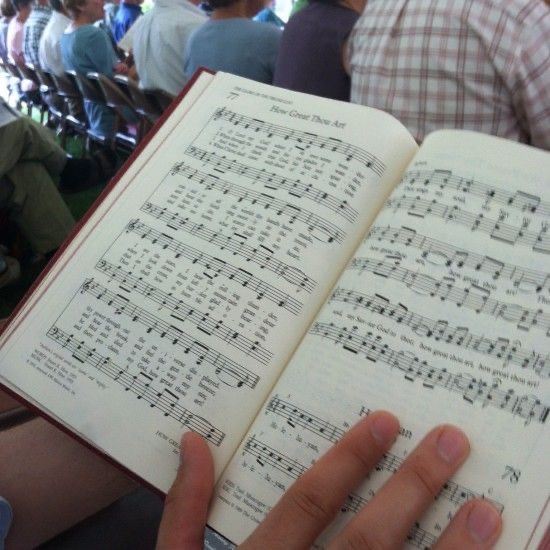
There is a unique kind of silence that accompanies a personal crisis, a heavy stillness where logic fails and words seem to vanish. On the worst night of my life, when the weight of grief and uncertainty felt physically crushing, I found that I couldn’t formulate a prayer or even a coherent thought. It was then that the verses of an old hymn began to play on a loop in my mind. This wasn’t a choice I made; it was a “harmonic anchor” that my subconscious dropped into the depths of my distress. It provided a structure for my pain, proving that when our own strength is exhausted, the rhythmic truths of a hymn can hold us steady.
The Power of Objective Truth
The reason that specific hymn worked—and why it still works today—is because it shifted my focus from my internal chaos to an external, unchanging reality. In moments of high anxiety, our feelings can be incredibly loud and often misleading, making us feel completely isolated. Hymns counter this by presenting “objective truths”—simple, factual statements about the nature of peace and resilience. By singing or even just whispering these words, I was essentially “re-tuning” my mind. The hymn didn’t change my circumstances immediately, but it changed my perspective, reminding me that while my situation was temporary, the principles of hope I was leaning on were permanent.
A Legacy of Shared Resilience
One of the most comforting aspects of a classic hymn is the knowledge that it was likely forged in a similar furnace of affliction. Many of the greatest hymns were written by people who were navigating their own “worst nights”—from losing family at sea to facing terminal illness. When we lean on these songs, we are tapping into a legacy of shared resilience. It works because it reminds us that we are not the first to walk through the fire, nor are we walking through it alone. This sense of historical connection provides a professional-grade level of emotional support, offering a tested blueprint for survival that has been validated by generations of survivors.
The Physiology of a Simple Melody
Beyond the spiritual and emotional benefits, there is a practical, physical reason why hymns are so effective in a crisis. The slow, steady meter of traditional hymns encourages deep, rhythmic breathing, which is the body’s natural way of deactivating the “fight or flight” response. On that difficult night, the cadence of the music helped slow my racing heart and calm my nervous system. This is why hymns remain a timeless recommendation for mental health; they are a holistic tool that engages the mind, the spirit, and the body simultaneously. They provide a “calm in the cockpit” that allows us to function even when the world around us feels like it is spinning out of control.
A Durable Resource for the Future
Ultimately, the reason this hymn continues to work is that it has become a permanent part of my “internal library.” Unlike a fleeting pop song or a temporary distraction, a hymn is a durable resource that grows more valuable with time. It serves as a reminder that I have survived before and can survive again. By integrating these “silent sermons” into our daily lives during the good times, we are essentially building a reservoir of strength for the bad times. To rediscover hymns is to equip yourself with a reliable, professional-grade tool for resilience—a song that waits in the shadows, ready to lead you back to the light whenever the night gets too dark.